
Understanding the F-Generations and ABC Designations in Savannahs
 The F Generation
You may be confused by the letter and number combinations we use with our Savannah Cats. Before the Savannah Cat became recognized as a domestic breed by TICA, these alphanumeric designations were used by breeders to categorize their cats by generation. The “F” stands for “filial” generation, that is, the number of generations the cat is removed from its Serval ancestor. For example, an F1 cat is one generation from a Serval, having a Serval as a sire.
Savannah Cats are classified by their generation, so breeders and prospective buyers can better predict temperament, coloring, and exotic markings.
The F1 cat is the largest hybrid offspring of a Serval-to-domestic mating. An F2 cat has at least one parent that is an F1. An F2 cat may not be quite as large as the F1, but will still retain many of the other characteristics of an F1.
An F3 cat, not as large as an F2, although still large, is even more domestic than an F1 or F2. F3 cats tend to be even more friendly with young children than the higher generation cats, and as such would be the best Savannah to bring into a family.
The filial (F) generation works independently from the A/B/C/SBT registration system.
The A/B/C/SBT Registration System
The A, B, C, and SBT designations are part of a code used by TICA to indicate the cat’s registration status and pedigree. Every cat registered with TICA has a registration or code number. In basic terms for a Savannah:
- A = one parent is not a Savannah (meaning one parent is a Serval, or a different domestic breed)
- B = one parent is not a Savannah (both parents are Savannahs, but one grandparent is a different breed)
- C = one great-grandparent is not a Savannah (both parents and grandparents are Savannahs, but at least one great grandparent is a different breed)
 If two “A” cats are bred, then the kittens are all “B” cats.
If two “B” cats are bred, then the kittens are all “C” cats.
If two “C” cats are bred, then the kittens are all “SBT” cats.
A kitten that has SBT (Stud Book Traditional) in its registration code has at least three generations of Savannah-to-Savannah matings in its pedigree. Therefore, only F4 kittens or later can be designated as SBT. A Savannah must be an SBT to show in the championship class.
Here are some sample crossings—
- “F1 A” x “F5 A” = F2B kittens
- “F2 A” x “F5 C” = F3B kittens
- “F3 C” x “F5 C” = F4 SBT kittens
- “F2 B” x “F5 SBT” = F3 C kittens
- “F1 A” x “outcross male” (not a Savannah) = F2A kittens
F1 Savannahs
F1 Savannah cats are the largest of the Savannah cats. They are 50% Serval and 50% domestic cat. The goal of responsible Savannah breeders is to produce a wild-looking, elegant cat with a domestic cat personality. Due to the laws of genetic inheritance, percentages of Serval higher than 50% in Savannah cats are only an estimate. An F2 Savannah will get 50% of its genes from an F1, and 50% of its genes from another cat, which may or may not be a Savannah. The F1 parent might pass on more domestic traits than Serval traits. Therefore, to know the exact percentage of Serval blood in a Savannah, other than an F1, would require genetic testing.
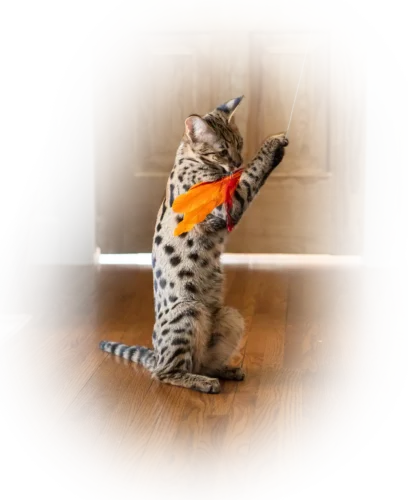 F1 Savannahs are beautiful, elegant cats that can turn heads when you bring one into a room. However, they are not for everyone. Since they are very close to the Serval, F1’s and usually F2’s demand a lot of attention. They are very curious, and can be quite mischievous. They often like to cavort around the house, and may knock your favorite trinkets over if you have things unsecured. They tend to be standoffish to strangers, and generally do not socialize well with children. While they are not aggressive cats, they typically prefer to bond with one or two people, and can be a bit snobbish to guests. They can jump about eight feet, and will often perch themselves on the highest piece of furniture, shelving, or other elevations in the room. Their size is often exaggerated, and people may think they get bigger than they actually do. F1 Savannahs have long legs and tall ears, but they appear heavier because of these traits. They are usually in the 15-25 pound range in weight, and will measure about 22-24″ from the chest to the base of the tail.
F2 Savannahs
F2 Savannah cats are similar to F1s in some ways, but not necessarily in others. Because of the laws of probability in genetics, some F2 kittens may look more Serval-like, while others may appear more domestic in looks. They will still have greater intelligence and energy than a non-Savannah, but may be somewhat more manageable than F1 Savannahs.
F3, F4, F5 Savannahs
Savannah cats in the F3 and later generations are typically better suited to busy or large families. These cats are usually more relaxed with a larger number of people, and generally more social with strangers. Savannahs, in general, are more intelligent and energetic than typical domestic cats. As such, these later generations will be more tolerant of being held, and will more favorably react to playtime. They may want to spend time on your lap, and will usually welcome playtime with children.